Related guides: Kratky guide · What Is Hydroponics?
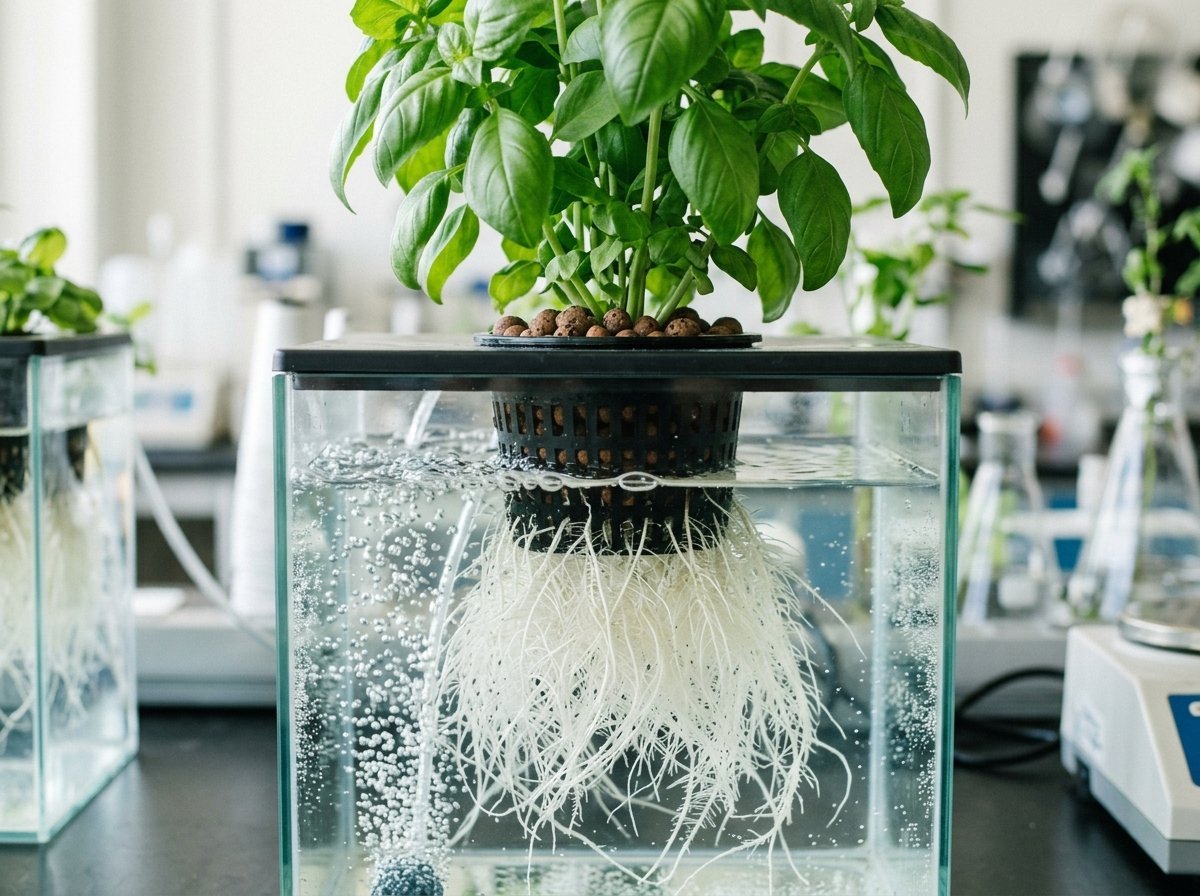
Deep water culture, usually called DWC, grows plants with their roots suspended in a reservoir of nutrient solution. An air pump and air stone continuously add oxygen to that water. The setup is simple enough for a first active system, but it depends on reliable aeration, a suitable water temperature, stable support, and a routine for checking the reservoir.
How DWC works
A DWC bucket or tote has four working parts: a reservoir, a lid or raft that supports the plant, a net pot or planting site, and an aeration system. Roots extend into the solution while bubbles break at the surface and move oxygen through the water. The plant receives water and dissolved nutrients directly rather than searching through soil.
The air pump does not replace good system design. A small pump cannot compensate for a reservoir that is too warm, a root mass that blocks circulation, a light leak that grows algae, or a plant that has outgrown its support. DWC is forgiving when these basics are matched; it can deteriorate quickly when aeration stops.
Parts of a beginner DWC system
- Opaque reservoir: A bucket or tote with enough volume for the crop and enough stability for its mature canopy.
- Net pot and lid: The plant sits above the water while roots grow through the pot. Leave room for the stem and growing medium.
- Air pump: Select a pump rated for the reservoir size and tubing length. Keep it outside the splash zone.
- Airline and check valve: The check valve helps prevent water from flowing backward if the pump stops.
- Air stone or diffuser: Use a clean diffuser that creates consistent bubbles without being crushed by roots.
- Growing medium: Use enough media to support the seedling but do not bury the stem or block the net pot.
- Light and support: The crop still needs appropriate light, airflow, trellising, and pollination where applicable.
Setting up the reservoir
Clean the reservoir, lid, tubing, and air stone before assembly. Fill with the measured water volume, mix the fertilizer according to its label, and then check pH and EC if those tools are available. Put the air stone where bubbles can spread through the reservoir, but keep it positioned so roots cannot easily pull it out of place.
Run the system with plain water before planting. Check that the pump remains dry, the tubing does not kink, the air stone bubbles consistently, and the lid does not wobble. Mark the normal water level. A record of volume, pH, EC, temperature, light schedule, and date makes later troubleshooting much easier.
Setting the water level
During early establishment, the nutrient solution may sit close enough to provide moisture to the lower growing medium. Once roots reach the reservoir, lower the level enough to leave an air space beneath the net pot. The bubbling solution can keep the exposed roots humid while the rest of the roots remain in the water.
Do not keep the entire net pot or stem base saturated. Constantly wet media around the crown can encourage rot and reduce the plant’s access to oxygen. The exact water level depends on the net-pot size, crop, and root development, so use the plant and roots as evidence rather than one fixed measurement.
Oxygen and water temperature
Oxygen is the defining management issue in DWC. Roots need oxygen for respiration, and warm water holds less dissolved oxygen than cool water. Keep the reservoir away from direct sun, hot fixtures, heaters, and warm equipment. Insulating the container can slow temperature swings, but it does not solve an overheated room.
Listen to the air pump and inspect the bubbles daily when the system is new. A silent pump, collapsed airline, clogged diffuser, or tripped outlet can leave roots underwater without enough oxygen. If the pump must be stopped, keep the interruption short and have a replacement plan for the crop’s size and sensitivity.
Choosing crops
Lettuce, basil, kale, herbs, and other compact greens are approachable DWC crops. Peppers and tomatoes can also grow well, but they require stronger light, a larger root zone, sturdier support, pruning, and pollination. A mature fruiting plant can consume water quickly and make a small bucket unstable.
Match the reservoir to the crop’s mature size rather than its seedling size. Crowded roots, a top-heavy canopy, or a nutrient solution that disappears between checks are signs the system may be undersized.
For the next step, see the NFT hydroponics guide.
Nutrients, pH, and EC
Use a complete hydroponic fertilizer and mix it into the actual water volume. Do not mix concentrated fertilizer parts together before dilution. If you use EC, take readings after the solution is mixed and record the meter’s calibration and units. PPM is not one universal scale, so write down the conversion convention alongside the reading.
pH affects nutrient availability, but chasing a perfect number can create instability. Calibrate meters, test at consistent times, and make small changes. If pH keeps drifting, investigate plant uptake, water alkalinity, nutrient strength, evaporation, and root health instead of repeatedly adding adjustment chemicals.
The EC to PPM calculator and PPM to EC calculator can translate a reading between common scales. They cannot tell whether a crop needs more fertilizer, so pair readings with new growth, root condition, light, and temperature.
Maintenance routine
Daily or near-daily checks
- Confirm the air pump is running and bubbles are reaching the reservoir.
- Look for leaks, unusual noise, wilt, heat stress, and a rapidly falling water level.
- Check that the plant is stable and the stem base is not sitting in water.
Weekly checks
- Measure and record pH, EC, water temperature, and reservoir level when possible.
- Inspect roots through an access point without exposing them to unnecessary light.
- Clean spilled fertilizer, remove dead plant material, and check tubing and the air stone.
Between crops
- Drain the reservoir and discard old solution.
- Clean and sanitize parts according to the material and product instructions, then rinse thoroughly.
- Inspect seals, pump output, check valves, net pots, and support before starting again.
Diagnosing common DWC problems
| Symptom | First checks |
|---|---|
| Wilted plant | Air pump, water level, root condition, heat, and recent transplant stress |
| Dark or soft roots | Warm water, weak aeration, light leaks, stagnant debris, and crown moisture |
| Yellow leaves | Light, pH, EC, root health, crop age, and whether new or old leaves are affected |
| Algae or green reservoir | Block light from the container, lid gaps, tubing, and exposed solution |
| Fast pH drift | Water alkalinity, nutrient strength, plant uptake, evaporation, and meter calibration |
| Pump failure | Outlet, tubing, check valve, diffuser, and a backup aeration plan |
DWC safety
Keep electrical connections above splash level, use drip loops, and disconnect power before putting hands near a submerged pump or air stone. Keep fertilizer concentrates away from children, pets, food, and unprotected surfaces. Wash edible harvests using normal food-safety practices and do not use unverified treatments in a food-growing reservoir.
DWC compared with Kratky
Kratky is passive and quiet; it uses a falling water level to create an air gap. DWC uses an air pump and keeps roots in an actively aerated reservoir. Kratky has fewer failure points but less flexibility for a large, thirsty crop. DWC provides more oxygen when maintained correctly but creates a dependency on the pump and electricity.
Read the Kratky guide for the passive alternative and What Is Hydroponics? for a comparison of major system types.
Frequently asked questions
Should DWC roots be completely underwater?
The lower roots can be in the nutrient solution, but the root mass and net-pot area also need access to oxygen. Leave an air space beneath the net pot once the roots are established.
How long can DWC run without an air pump?
There is no universal safe time. Crop size, water temperature, root mass, and reservoir shape all matter. Treat a stopped pump as a problem to solve promptly rather than relying on a fixed countdown.
Does DWC need a water chiller?
Not every home system does. A chiller may be useful when the room consistently keeps the reservoir too warm, but shade, insulation, ventilation, and cooler equipment placement should be reviewed first.